
-
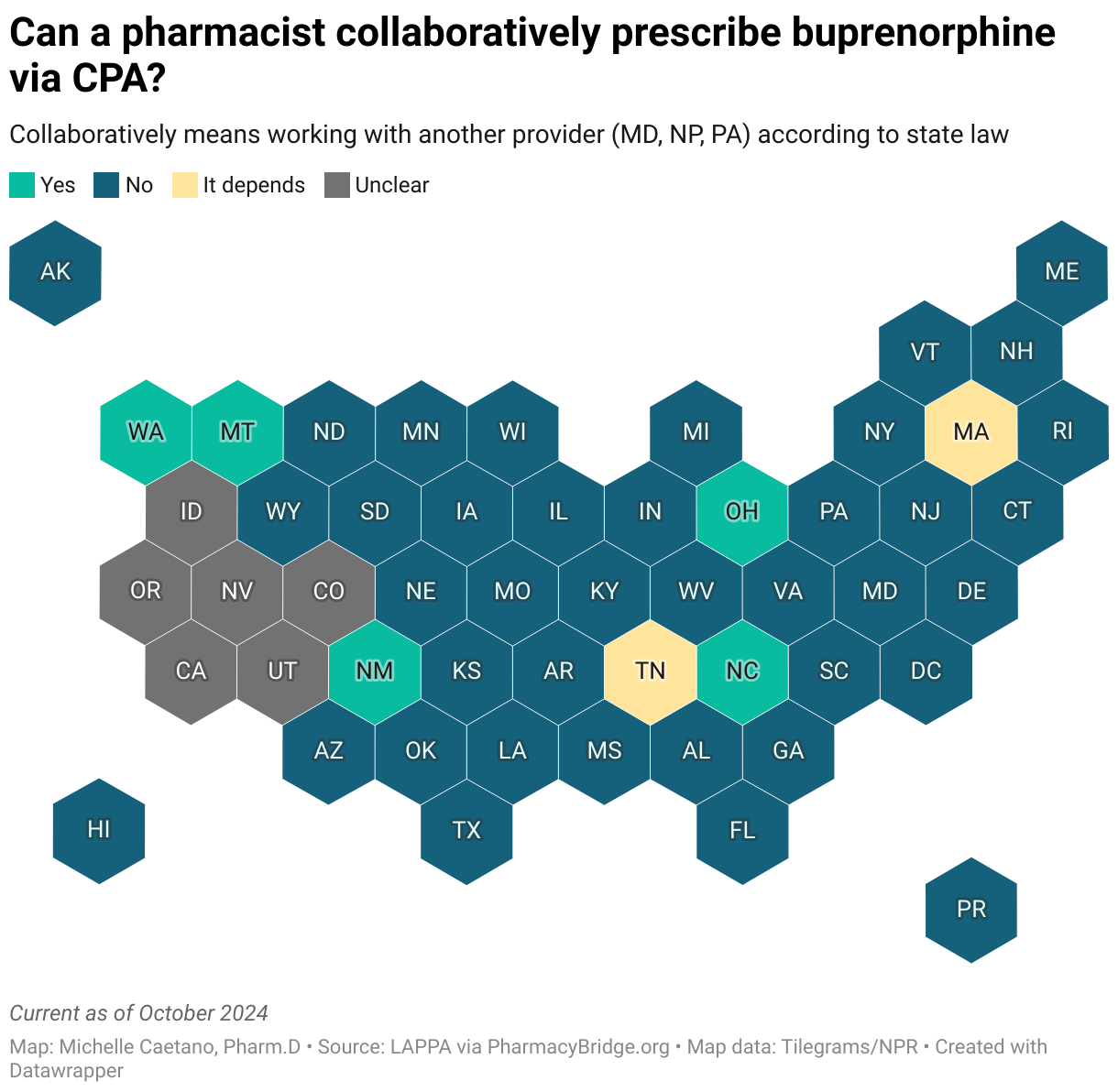
Can a pharmacist prescribe buprenorphine via a collaborative practice agreement (CPA)?
The upfront answer to this question is “yes” only if a state’s pharmacy laws/regulations do two things.
First, a state’s laws/regulations governing CPAs must provide a clear authorization for a pharmacist to prescribe categories of drugs and medications that include either controlled substances generally, or MOUD specifically.
Second, those laws/regulations must clearly authorize and direct the pharmacist to obtain the DEA’s mid-level practitioner registration, which is a prerequisite to pharmacists prescribing controlled substances.
-
Can a pharmacist prescribe buprenorphine via a collaborative practice agreement (CPA)?
Five states where the answer is “yes” without caveat; Montana, New Mexico, North Carolina, Ohio, and Washington.
Two states where the answer is “yes,” but only if the CPA involves a pharmacist practicing in certain specified non-community/retail pharmacy settings; Massachusetts and Tennessee
One state where forthcoming regulations will likely make the answer “yes”; Colorado
Four states where pharmacy laws/regulations governing CPAs do not address prescribing controlled substances or MOUD, but pharmacists have authority to prescribe them (in general or in limited cases) outside of a CPA; California, Idaho, Nevada, and Oregon.
One state where available information makes the answer “unclear; Utah
37 states, the District of Columbia, and Puerto Rico where the answer is “no”; all jurisdictions not listed in the bullets above
In these states, the limiting factor usually is either that pharmacy laws and regulations governing CPAs:
do not clearly authorize and direct pharmacists to obtain the DEA’s mid-level practitioner registration; or
generally prohibit CPAs from involving controlled substances.
Although it is not the reason why a state’s upfront answer to this question is “no,” LAPPA notes that these findings show that in many states, the laws and regulations governing CPAs do not clearly authorize a pharmacist to prescribe drugs or medications of any kind. Instead, these provisions describe pharmacist practice under CPAs using terms such as “initiating,” “adjusting,” or “modifying” drug therapy without defining the scope of activities that the terms encompass.
This lack of specificity about practice under CPAs more directly affects LAPPA’s findings regarding direct administration as well as ordering and evaluating laboratory tests because in those cases, the lack of a provision addressing the need for DEA’s mid-level practitioner registration to prescribe controlled substances does not immediately preclude a “yes” answer.
More details about each state’s laws and regulations can be found in the individual state charts.
-