
Legal and Educational Resources
-
LAPPA Model MOUD CPA Act
The Model Pharmacist Collaboration for Medication for Opioid Use Disorder (MOUD) Act, drafted in collaboration with the Center for Health Law Studies at the St. Louis University School of Law, can help to save the lives and improve the health and quality of life of individuals who have an opioid use disorder (OUD). This Act does so by increasing the health care workforce that provides medication for OUD by authorizing pharmacists to:
(1) Prescribe medications for OUD for treatment and refer patients for long-term treatment;
(2) Prescribe, initiate, monitor, and adjust long-term treatment pursuant to collaborative practice agreements for collaborative drug therapy management.
The Act further requires Medicaid and private health insurance coverage for pharmacists’ comprehensive patient care and medication management services. It also provides for the establishment of a grant program to incentivize and sustain interprofessional collaborations that include pharmacists through educational programs, statewide initiatives, community programs, and pilot programs.
-
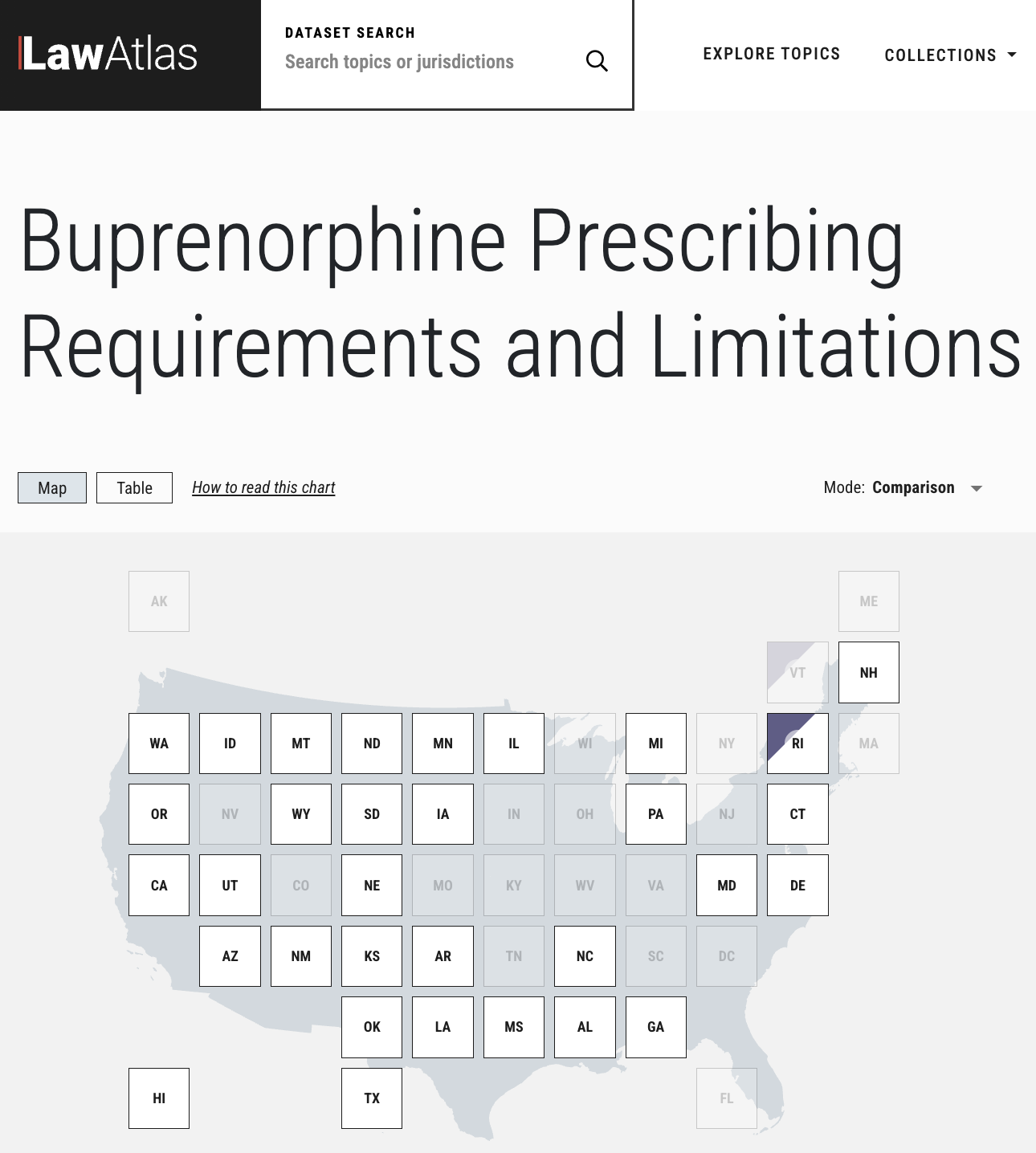
LawAtlas State Buprenorphine Policies
Some state regulatory schemes maintain restrictive barriers to buprenorphine treatment access. These barriers include constraints on dosage, product formulation, and prescription length; and imposing high-threshold practices such as mandatory counseling and frequent drug testing. Conversely, state laws can be protective, such as by requiring the provision of the opioid overdose reversal drug naloxone and prohibiting punitive responses when patients decline counseling or other ancillary services.
This dataset is longitudinal and displays key features of state-level statutes and regulations regarding buprenorphine prescribing for OUD outside of federally certified opioid treatment programs. The dataset includes laws across all 50 states and the District of Columbia in effect as of March 1, 2023, through September 1, 2024. The dataset does not include laws or policies that regulate buprenorphine prescribing exclusively within state Medicaid programs.
These data were created with support from the Vital Strategies Overdose Prevention Program.
-
Pharm-OUD Guideline
Buprenorphine’s accessibility, efficacy, and relative safety make it the gold standard for the management of opioid use disorder. Still, around half of community pharmacies in the United States do not maintain buprenorphine in their inventory. Community pharmacists must contend with a convoluted meshwork of state and federal laws and regulations that complicate the wholesale purchase and dispensing of buprenorphine. Additionally, stigma toward persons with opioid use disorder often interferes with the quality of care delivered at the pharmacy counter. The Pharmacy Access to Resources and Medication for Opioid Use Disorder Guideline was created to provide actionable steps to improve access to buprenorphine in community pharmacies.
Pharmacists should dispense buprenorphine under most circumstances pursuant to a valid prescription from a DEA-licensed prescriber. Caution is warranted when applying quantitative thresholds to buprenorphine dispensing decisions, and pharmacists should rely on their professional judgment rather than arbitrary decision rules that prioritize liability reduction over patient health and safety.
-
Strategies to Address Opioid Stigma in Pharmacies
To address this crisis, the Centre for Addiction and Mental Health (CAMH) has created a toolkit that provides valuable insights and resources for frontline pharmacy professionals to support people taking opioids to mitigate the negative impacts of stigma.
The toolkit describes strategies for reducing stigma around opioids and people who use them, including people who are prescribed opioids to manage pain or treat opioid use disorder or who are seeking naloxone kits. It illustrates some of these strategies by applying them to situations that pharmacy professionals may encounter in practice.
-
Buprenorphine Resource Initiative for Dispensing Guidance and Education
The Buprenorphine Resource Initiative for Dispensing Guidance and Education (BRIDGE) aimed to identify and mitigate pharmacy-level barriers to dispensing buprenorphine for opioid use disorder (OUD) in rural Appalachian communities. The P2P team seeks strategies that can be implemented statewide to increase access to buprenorphine in community pharmacies and improve care for patients with OUD.
Focus groups of pharmacists and pharmacy technicians working in high- and low-dispensing counties informed the development of a pharmacist-to-pharmacist educational outreach initiative, which was conducted in 2024-2025. Surveys and dispensing data are currently being analyzed to evaluate changes in pharmacist attitudes and behaviors following the intervention. Free continuing education activities, pharmacist educational materials, and patient handouts remain available online to help all pharmacy personnel improve buprenorphine dispensing.
-
AAPP Toolkits and Clinical Resources
AAPP members have developed tools and toolkits to benefit fellow psychiatric pharmacists and to further the knowledge of other pharmacists and healthcare professionals. You are encouraged to share these to educate others and highlight the value of psychiatric pharmacists.
Substance-Related Disorders
General: Guidelines, Major Clinical Trials
Buprenorphine Initiation: Toolkit
Harm Reduction: Toolkit
Methadone Versus Buprenorphine for Treatment of Opioid Use Disorder
Opioid Use Disorders: Medication Management: Toolkit
Pain Management in Patients with Substance Use Disorder(s)
Pain Management Pearls for Patients with Chronic Pain or Opioid Use Disorder: Toolkit
Urine Drug Screens: Toolkit, Utilization in Clinical Practice
Xylazine: Toolkit