
-
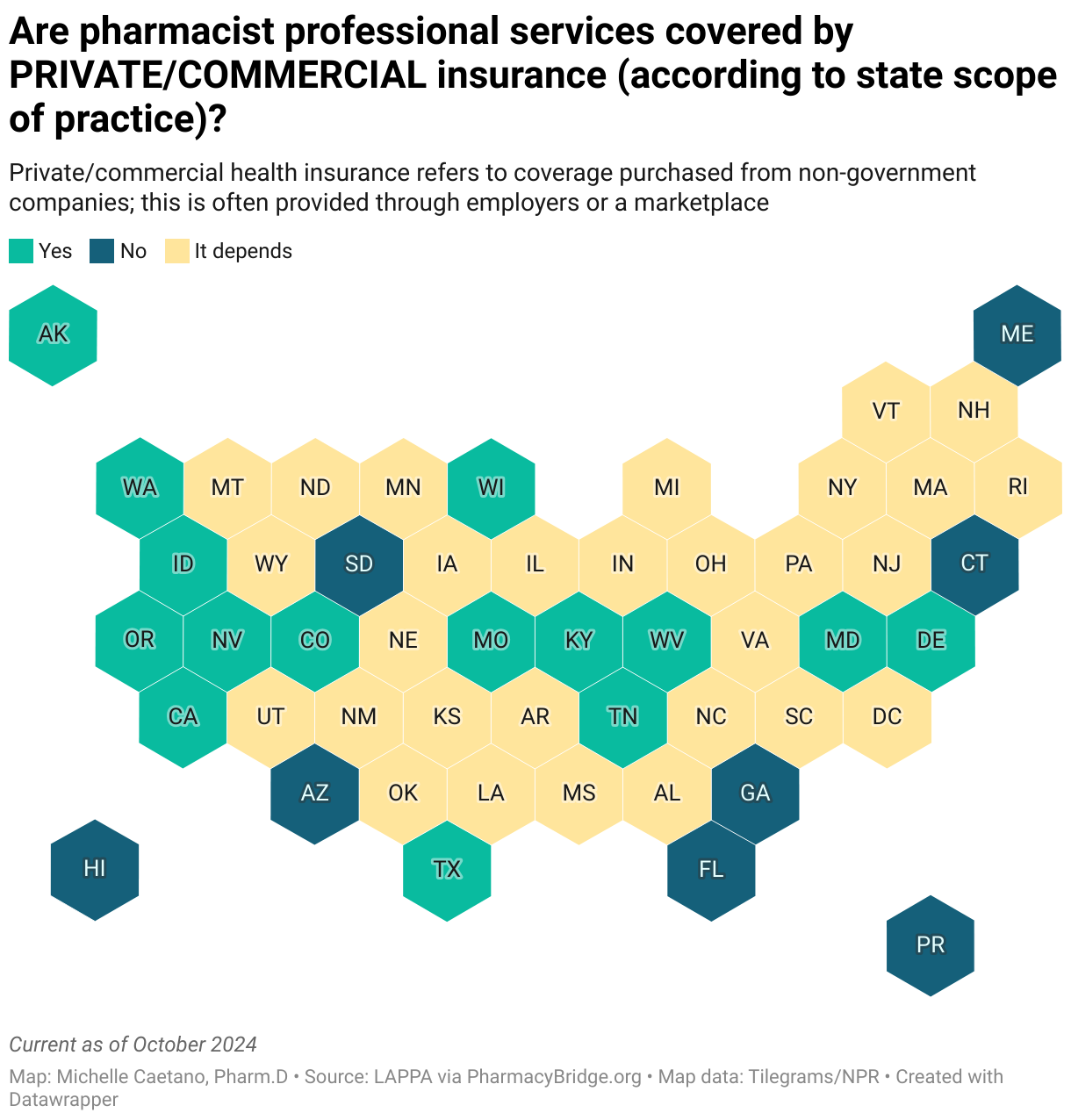
Are pharmacists’ professional services covered by PRIVATE/COMMERCIAL insurance?
An important aspect of whether individual pharmacists will participate in pharmacy-based buprenorphine induction and maintenance services is the extent to which the pharmacist will receive health insurance reimbursement for clinical services provided. Pharmacists are not universally recognized as healthcare providers eligible for reimbursement by Medicare Plan B (medical insurance not including prescription drug coverage), state Medicaid programs, or commercial insurance plans. While pharmacist “provider status” under Medicare is function of federal law, state laws and regulations can allow or require state Medicaid programs and commercial insurers to cover a limited or full range of pharmacist services.
LAPPA reviewed state laws/regulations governing Medicaid benefits and commercial insurance plans, as well as two recent surveys that proved very useful (see references below). Although the question focuses on coverage under state Medicaid programs, where state laws/regulations/policies address commercial insurance coverage requirements, the response notes this as well.
References:
Jonathan Hughes, State of the Union: A Review of State-based Laws and Regulations Supporting Pharmacist Payment for Clinical Services, Clinical Pharmacy Forum (July 26, 2024) at https://accpjournals.onlinelibrary.wiley.com/doi/10.1002/jac5.2008.
Pharmacist Authority to Initiate PrEP & PEP and Participate in Collaborative Practice Agreements, Nat’l Alliance of State & Territorial AIDS Directors (Aug. 10, 2023) at https://nastad.org/sites/default/files/2023-08/PDF-Pharmacist-Authority-Initiate-PrEP-PEP.pdf
-
Are pharmacists’ professional services covered by PRIVATE/COMMERCIAL insurance?
Fifteen states where pharmacists’ professional services are covered by commercial insurance plans; Alaska, California, Colorado, Delaware, Idaho, Kentucky, Maryland, Missouri, Nevada, Oregon, Tennessee, Texas, Washington, West Virginia, and Wisconsin
Seven states and Puerto Rico where no pharmacists’ clinical services appear to be covered under commercial plans; Arizona, Connecticut, Florida, Georgia, Hawaii, Maine, Puerto Rico, and South Dakota.
29 jurisdictions where commercial insurance may cover a limited set of pharmacist services - coverage will vary based on each insurance plan’s policies; Alabama, Arkansas, California, Illinois, Indiana, Iowa, Kansas, Louisiana, Massachusetts, Michigan, Minnesota, Mississippi, Montana, Nebraska, New Hampshire, New Jersey, New York, North Dakota, Oklahoma, Pennsylvania, Rhode Island, South Carolina, Utah, Vermont, and the District of Columbia.
More details about each state can be found in the individual state charts.
-
Please refer to the following resource published 5/14/2026:
Advancing Pharmacist Payment Parity Workgroup, J. Hughes, E. M. Murphy, K. Robb, et al., "State of the Union 2026: State-Level Updates and National Trends in Pharmacist Payment Reform," Journal of the American College of Clinical Pharmacy 9, no. 6 (2026): e70214, https://doi.org/10.1002/jac5.70214.The full supplementary table (Table S1) with 50-state comparison data is freely available from the publisher: